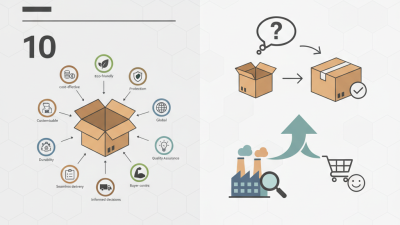
A Cardboard Box crossing oceans faces more than distance. It may sit in humid ports, endure stacked pallets, and meet repeated handling before reaching its destination. The United Nations Conference on Trade and Development’s Review of Maritime Transport 2024 reports that over 80% of world merchandise trade by volume moves by sea. That scale makes packaging choices operational, not cosmetic.
There is no single “best” box for every shipment. The right design depends on product weight, dimensions, fragility, route, and storage conditions. Corrugated board offers practical cushioning and can be specified in different grades, but a thicker box is not automatically a safer one. Poor sizing can leave products shifting inside; excessive empty space also raises freight costs. Small details matter. A tight fit helps.
For evidence-based selection, buyers can consult the International Safe Transit Association’s shipment-testing procedures and request board specifications from packaging suppliers. The World Bank’s Logistics Performance Index also highlights the importance of reliable transport and handling across supply chains. These sources do not replace testing a real packed product. They help frame it. A useful evaluation compares box strength, closure method, internal protection, and performance after humidity or compression exposure. One honest limitation: published ratings cannot fully predict every route’s rough handling. The best choice is the box that protects the item under its actual shipping conditions, with test results and supplier data to support the decision.

A cardboard box for global shipping must survive drops, vibration, compression, and changing humidity. The International Safe Transit Association’s 3A protocol tests these stresses through free-fall drops, vehicle vibration, and atmospheric conditioning. A suitable box should match that reality, not only look strong in a warehouse.
Choose double-wall corrugated board for heavy, fragile, or long-distance shipments. Check the edge-crush test rating before packing. Stronger fluting supports stacking, while moisture-resistant coatings help during port transfers and rainy unloading. Still, coatings can reduce recyclability. That trade-off deserves attention. The U.S. Environmental Protection Agency reported that paper and paperboard containers generated 33.3 million tons of waste in 2018, with a 96.5% recycling rate. Clean, fiber-based construction remains a practical choice.
Tips: Measure the product and leave limited cushioning space. Excess empty space increases movement and dimensional weight. Seal every major seam with pressure-sensitive tape, then test one packed box with a one-meter drop. Use a box that closes without bulging. Mark orientation only when the contents truly need it. A perfectly engineered box can still fail if wet, overfilled, or stacked beneath heavier freight. For repeat shipments, record box dimensions, gross weight, damage patterns, and destination climate. These simple records reveal whether the selected board grade works outside controlled conditions.
There is no single best box for every shipment. Choose corrugated packaging based on the product’s weight and fragility, the shipping route, handling conditions, and any applicable carrier or destination requirements.
| Selection Factor | Suitable Choice or Practical Guidance | Why It Matters in Global Shipping |
|---|---|---|
| Corrugated construction | Use single-wall board for many lightweight, non-fragile products; consider double-wall board for heavier, fragile, or higher-risk shipments. Triple-wall board is generally reserved for demanding loads and specialized applications. | Additional fluting and liner layers can improve cushioning and stacking resistance, but the appropriate construction depends on the packed load and distribution conditions. |
| Board strength | Check the box maker’s certificate for edge crush test (ECT) or bursting-strength information. Select a rating based on packed weight, box dimensions, stacking, and handling; do not choose by rating alone. | ECT relates to edgewise compression performance, while bursting strength measures resistance to rupture. Neither value by itself guarantees performance in every shipping environment. |
| Flute profile | B-flute is often used where a relatively compact, crush-resistant box is useful; C-flute is a common general-purpose profile; E-flute is thinner and often suited to smaller packages and print quality. | Flute profiles differ in thickness, cushioning, and stacking characteristics. The best choice depends on product protection and the space available for packaging. |
| Box dimensions | Choose internal dimensions that fit the product and protective materials without excessive empty space. Measure the packed item, not just the product before cushioning. | A close-fitting package helps limit movement and can reduce unnecessary dimensional weight. Allow enough room for effective cushioning on all sides. |
| Product cushioning | Use suitable cushioning, dividers, or inserts for fragile items. Immobilize the contents and keep them from contacting the box walls where impact damage is a concern. | Corrugated board is not a substitute for product-specific cushioning. Long routes can involve repeated handling, vibration, and drops. |
| Moisture exposure | For routes with possible humidity or wet handling, consider moisture-resistant packaging or an appropriate inner protective layer. Keep the package dry before sealing. | Moisture can weaken corrugated board and reduce stacking strength. A water-resistant treatment can help, but it does not make an ordinary cardboard box waterproof. |
| Sealing method | Use a strong, compatible packing tape and seal all main seams securely. For heavier parcels, apply tape across the center seam and along the edge seams. | Secure closure helps prevent the box from opening during transit. Tape selection and application should match the box surface, package weight, and conditions. |
| Stacking and palletization | Use a box designed for the expected load above it. When palletized, keep cartons aligned, avoid unsupported overhang, and use suitable wrapping or strapping. | Compression performance can be affected by humidity, storage time, box dimensions, and pallet arrangement. Actual stacking conditions should guide box selection. |
| Marking and labels | Apply complete, legible shipping and handling labels to a flat, visible surface. Keep labels clear of seams and corners, and follow carrier and destination-country requirements. | Clear labels support identification and routing. Required documents and markings vary according to the goods, destination, and shipping method. |
| Testing and validation | For valuable, fragile, heavy, or recurring shipments, test the complete packed configuration under conditions representative of the distribution route. | Package performance depends on the product, box, cushioning, closure, and handling system together. A test standard or supplier rating cannot replace route-specific assessment. |